Electric Heater Buying Guide: Efficiency, Costs, and Core Types Explained
Buying a new electric heater? Learn how to choose the right core (Dry, Fluid, Ceramic), calculate running costs, and ensure you get the best efficiency and safety for your home.
EASY GUIDE
5/8/20245 min read

The Ultimate Electric Heater Buyer's Guide: From Watts to Winning Efficiency
You don't need a physics degree to understand electric heating, but you do need to understand the key concepts that separate a smart, efficient radiator from an expensive space heater.
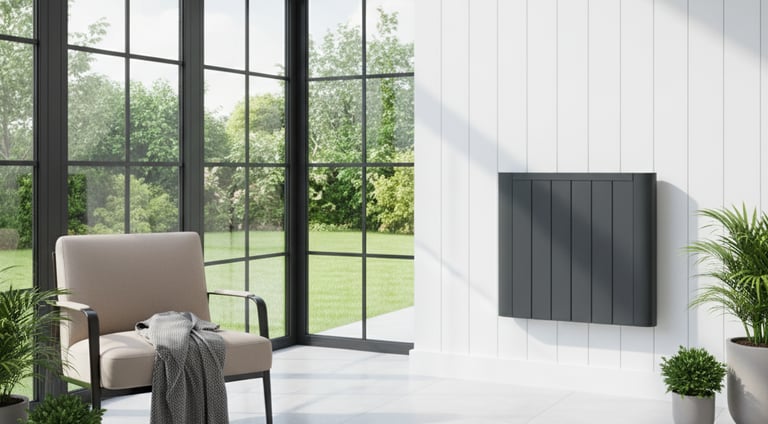
Our Serre Electric heater is a best seller, ideal for almost any room, read on to find out about more about consideration when choosing an electric heater.
This is your ultimate, jargon-free guide to electric heating, designed to be the only resource you ever need to confidently choose, install, and run the perfect electric radiator.
1. The Core Difference: Dry vs. Liquid vs. Ceramic
Modern electric radiators all convert electricity into heat with near 100% efficiency at the point of use. The real difference lies in how they store and release that heat using their core material.
2. The Secret to Comfort: Radiation vs. Convection
This is the most important concept most people miss. All heaters use a combination of these two methods, but the ratio matters immensely for your comfort and energy bill.
The Takeaway:
Look for radiators that emphasise radiant heat (e.g., Ceramic or high-quality Aluminium units). The better a heater is at radiation, the more comfortable the room will feel at a lower thermostat setting, leading to energy savings.
3. The Law: EcoDesign Lot 20 Compliance
Since January 2018, all Local Space Heaters sold in the UK—which includes both permanently installed electric radiators and portable/plug-in heaters—must adhere to the EcoDesign Lot 20 efficiency standard. This is not about the core material; it's about the smart controls that stop you from wasting energy.
The Towel Rail Exemption: Understanding Functionality
The key difference for electric towel rails hinges on their primary purpose, as defined by the original EU Regulation 2015/1188 (Article 1, point (b)): units are exempt if they are "specified for purposes other than indoor space heating to reach and maintain a certain thermal comfort."
Bottom Line: For primary space heating, the advanced, intelligent controls of Lot 20 compliant units are the true source of your long-term energy savings.
Mandatory Lot 20 Features
Any newly manufactured heater intended for space heating must include these mandatory features:
Need More Detail? The Ecodesign for Energy-Related Products Regulations 2018 (retained UK law for Lot 20) governs these standards. You can read the full UK legislation here
4. Simplified Cost Calculation: The 1kW Rule
You do not need a formula or a physics degree. The key is understanding the two units used in heating:
W to kW: The Essential Conversion
The power of a heater is listed in Watts (W) (e.g., 500W, 1200W).
Your electricity bill measures usage in Kilowatt-hours (kWh).
1 Kilowatt (kW) =1000 Watts (W)
The simplest cost calculation in the UK is the 1kW Rule:
A 1000W (or 1kW) heater running at full power for 1 hour uses exactly 1kWh of electricity.
Using the current UK average unit rate of 26.35 pence per kWh (late 2025 estimate):
Learn more about Watts and BTU's in our guide here
The Real Cost Secret
Thanks to Lot 20 controls, your heater will never run at full power for a solid hour once the room is warm. After the initial warm-up, a smart radiator with a precision thermostat will cycle on and off, often running at 100% power for only 20−30 minutes of every hour to maintain the temperature.
5. Location, Location, Location: Bathroom Safety (IP Ratings)
Putting an electrical appliance near water requires strict safety compliance, measured by the IP (Ingress Protection) rating).
Understanding the IP Code & Real-World Protection
The IP code always has two numbers:
First Digit: Protection against solids (dust, tools, fingers). (E.g., IP24 means protected against objects >12mm).
Second Digit: Protection against liquids (water). (E.g., IP24 means protected against splashing water).
Bathroom Zones (Installation Requirements)
IP24 & Bathroom Installation: A Critical Safety Warning
An IP24 rating, which is common on electric radiators like the Serre, means the unit is protected against solid objects >12mm (the '2') and protected against water splashed from any direction (the '4').
While an IP24 rating technically meets the minimum legal requirement for Zone 2 installation, we at RadiatorStore.uk strongly advise against its use anywhere in a bathroom.
We have been in the industry long enough to know that sometimes corners are cut and rules are stretched. We recognise that children love a splash in the bath and that accidents involving water are common. We would rather lose a sale than deprive a child of the fun of splashes in the bath or worse still risk a life. This choice is made because the IP24 rating assumes only minor splashing, and real-world moisture often goes far beyond that technical minimum.
Any of the following real-world events can easily exceed this protection rating:
Unintentional Accidents: An errant aim of the shower head or an overflowing bath.
Excessive Moisture: A poorly ventilated room creating large amounts of condensation.
Splashing: Water splashed directly onto the heater.
Aggressive Cleaning: A powerful, directed spray from a handheld shower or a steam cleaner aimed near the unit.
Understanding the IP ratings puts bathroom safety into clear perspective. It is important to remember the distinction between a dedicated electric space heater and a towel warmer. Many electric towel bars are designed only to dry and warm towels—meaning they are exempt from strict heating regulations and their primary function is not room heating. When you are looking for an electric unit intended to heat the room, you must look closely at its IP rating.
For example, a unit with an IP24 rating is technically compliant to be situated within certain bathroom zones as it is protected only against casual splashing water. However, life tends to have many more variables than lab tests: children splash, shower heads get misdirected, and broken fans can quickly increase humidity and moisture.
Compare this to a modern smartphone like the iPhone 15, which boasts an IP68 rating—it is completely sealed against dust and can be submerged in deep water for up to 30 minutes.
If an IP24 heater is the bare minimum for an appliance wired to your mains in a high-moisture room, ask yourself: Would you be comfortable leaving your £1000 smartphone constantly exposed to the elements inside your bathroom? The answer is almost certainly no, so why would you risk a lower rated device which is wired up to the mains? Instead of settling for the technical minimum, consider a different approach: our Adria range of high-output double towel rails are central heated, not electric. This means they contain no electrical components and require no IP rating, entirely eliminating the electrical risk of a lower-rated unit. If you are in the hunt for something to heat your bathroom, keep your towels toasty, and allow a bit of splash time in the bath, then head over to our store now and take a look.
The Adria Difference: Power and Style
Our range of Adria double towel rails is a perfect example of this modern solution. They are designed to offer exceptional heat output, providing enough warmth for most bathrooms. The smart double-panel design allows for a much higher BTU output than a standard towel rail, without taking up a huge amount of wall space.
You can view our full range of Adria double towel rails here.
The Adria is available in popular sizes like 800mm, 1200mm, 1500mm, and 1800mm in height, and in widths of 400mm, 500mm, or 600mm. These towel rails supply an outstanding heat output.
For example, one of the most popular sizes, the 1200mm x 500mm Adria, produces an amazing 3102 BTU at T-50. That’s a serious amount of heat for a towel rail this size! All of our radiators at RadiatorStore.uk and on our sister site Heatsensehub.com are clearly shown with their output at the modern T-50 standard, making it easy to compare and find the perfect fit.
To check if this is enough for your room, you can use our handy BTU calculator over at heatsensehub.com/calculator. It’s quick, simple, and will help you choose the perfect size to suit your needs.
© 2025. All rights reserved.
Find Us On Instgram